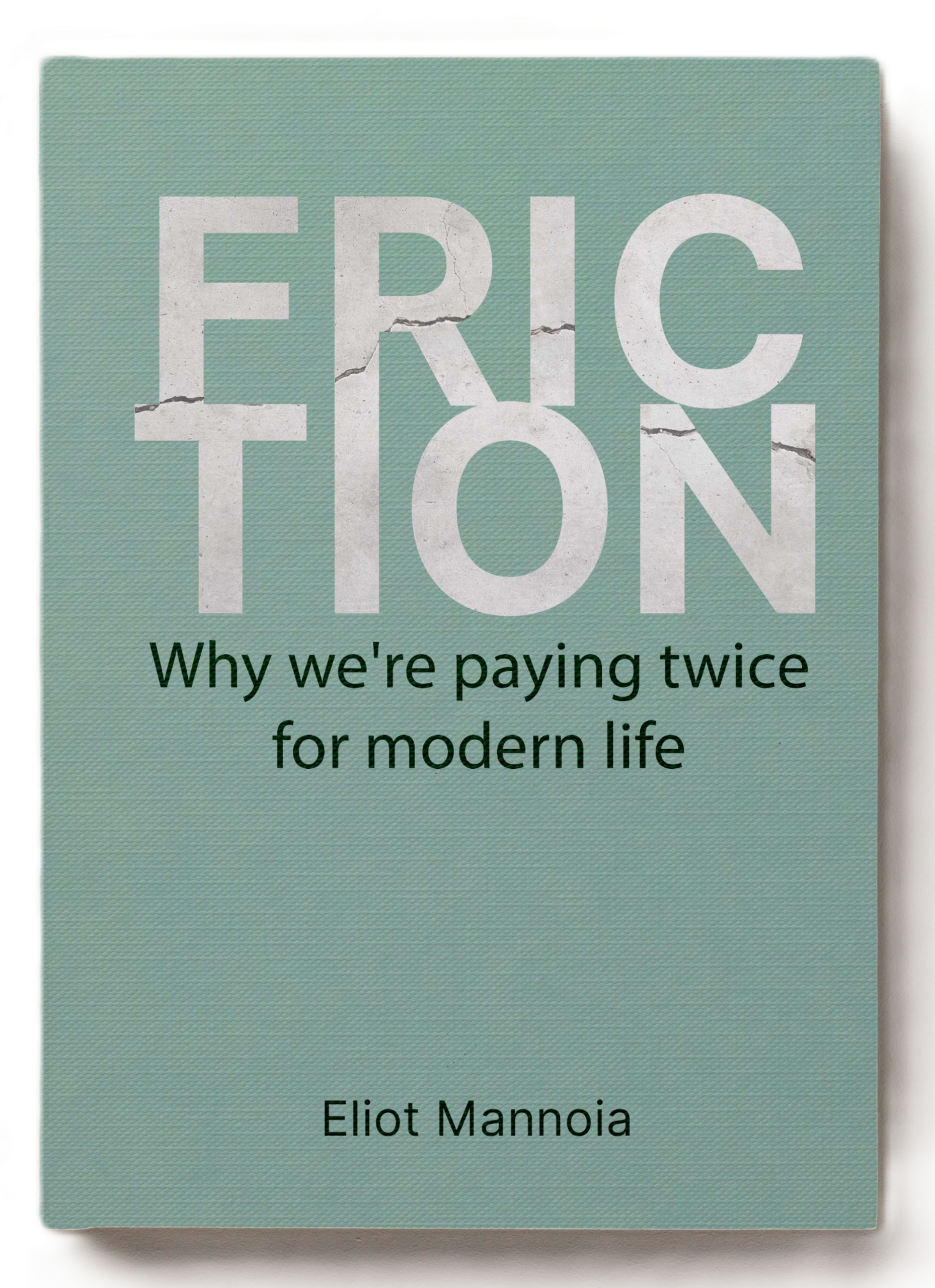
Friction - Why we're paying twice for modern life

DIGITAL PSYCHOLOGY
Why the life we made easier still feels hard to live
We take the escalator all day, then pay a gym to climb its stairs. We download meditation apps to recover the stillness our devices helped erode. We swipe for connection in cities packed with people. A six-trillion-dollar wellness industry now sells back the effort, focus, and texture that ordinary life once supplied without branding.
Something else is happening too. We are becoming more like our machines, and they are learning to seem more like us.
Through three lives spanning three generations, Eliot Mannoia traces where the effort went, what we lost with it, and what he calls Artificial Hardship, the practice of restoring what convenience removed. Friction is not an argument against progress. It is a practical, deeply researched guide for staying human enough to find each other.
We developed ways to need each other less.
Now we have to learn how to want each other.
— From the conclusion
What readers are saying
Eliot Mannoia asks a quiet yet unsettling question: what makes us human in a world where life no longer presents us with challenges? He explores a shift that is too recent to fully understand, too pervasive to step outside of and too attractive to easily resist. As we gain convenience by eliminating friction, from waiting and wandering to uncertainty and effort, we risk losing something harder to name. Without resistance or the minor challenges that foster awareness and connection, we must consider which aspects of ourselves begin to fade when life becomes entirely smooth. This book is a quiet, lingering reflection on humanity in an age of ease that leaves behind questions that echo long after the final page.
Reading Friction, I kept recognising connections to my own work in neuroscience and to ordinary life. Mannoia gives clear language to something easy to overlook: effort, constraint, contrast, and embodied engagement can matter for learning, attention, memory, and adaptation. What I appreciated most is his restraint. He does not force the evidence into a simple slogan, but uses it to ask better questions about what convenience may quietly change in us.
A thought-provoking and timely book that challenges us to reflect on our use of technology and preserve human agency.
The book nails something I couldn’t quite articulate before reading it: that modern convenience isn’t free, we just pay the invoice later, in ways we barely notice.
The opening image of a guy paying to climb stairs after spending the day avoiding them is the kind of observation that makes you put the book down and look around.
The book is not nostalgic or anti-technology… It’s just honest about the trade-offs we stopped questioning. I’ve caught myself thinking about it in random moments, at the gym, using an elevator, ordering delivery.
It made me more aware of these patterns in my own life, and I think that’s already a good step in the right direction.
“Friction”, written by Eliot Mannoia, offers a captivating exploration of what it means to live a life with friction versus one that is increasingly frictionless, through compelling storytelling and insightful, practical concepts-building. A great strength of the book is how it encourages readers to develop their own compass for navigating the role of technology in their lives—helping us discern when to embrace digital convenience and when to intentionally return to more analogue ways of being/living. Rich with thought-provoking research, facts, and observations, the book repeatedly prompted me to pause, reflect, and question my own habits and assumptions. At a time marked by geopolitical uncertainty and the rapid evolution of technology and AI, its message feels especially timely and relevant.
Rather than advocating for the rejection of tech-innovation, the book makes a powerful case for preserving our humanity, health, and wellbeing through a thoughtful balance between traditional practices and technological advancement. The choice is ours.
A guide to staying human in the age of AI. Mannoia names what the rest of us have only been feeling.
An overview of the journey
Prologue A young man alone in his apartment. Deliveries arrive without knocking. His AI companion remembers everything. Comfortable. Efficient. Isolated.
Introduction Liverpool Street station, Monday morning. A lawyer watches thousands ride the escalator. In ten hours, he’ll pay to climb stairs in a gym. The realization lands.
Chapter 1: The Pattern We erased the stairs, rebuilt them indoors, and sold them back wrapped in metrics. The pattern starts in the body, then spreads to memory, relationships, and the economy. Three witnesses enter: Michael, Maya, and Evelyne.
Chapter 2: Creating Contrast Maya wakes feeling fine. Her watch disagrees. The body needs rhythm, not optimization. Spikes and valleys, not a flatline. Creating Contrast is the first tool.
Chapter 3: Hearts and Algorithms Dating apps as emotional StairMasters. AI companions offering perfect attention without risk. A question surfaces: how do we love each other when machines provide an easier alternative?
Chapter 4: The Next Generation Kai is ten. He confides in his AI companion because his parents are distracted. The boredom extinction event. Artificial Hardship enters as the second tool.
Chapter 5: The Infinite Office Lucia works from São Paulo, training AI for three cents an image. The invisible labor behind our seamless machines. The Human Curve appears as the third tool.

Chapter 6: The Convergence Two therapy transcripts. One human, one machine. Indistinguishable. Strange Symmetry reveals itself: we’ve been teaching machines to be human while they’ve been teaching us to be artificial.
Chapter 7: The Blueprint Diagnosis complete. A Repair Café opens the chapter. The Friction Framework synthesizes. The Friction Compass, the Audits, and the Tribe Vibe Playbook offer a practical way forward.
Conclusion: Human Enough Liverpool Street station again. A different person looks up. Friction isn’t failure. It’s function.
Epilogue: Six Months Later Michael walks to a colleague’s office. Maya demotes her AI from confidante to assistant. Evelyne buys potatoes and three old peelers. Some Sundays work. Some don’t. She keeps buying potatoes.
We are becoming artificial humans
GET FRICTION
Available in print, audio, and ebook
Friction Theme

LISTEN TO THE IDEAS
Two AI hosts discuss Friction for an hour. Yes, the irony is intentional.
Generated by Google NotebookLM from the manuscript.
Digital psychology
THE IMPACT OF TECHNOLOGY ON US
Digital psychology is the study of how technology influences thinking, behavior, and identity in ways we don’t always notice. It sits at the intersection of cognitive science, behavioral research, and design, asking a question most fields avoid. What is the technology actually doing to us, beyond what we use it for? Not whether a tool works, but what kind of person we become while using it. Not whether a feature is convenient, but what capacities quietly atrophy when convenience replaces effort.
The field treats interface decisions as value choices. Every default setting, every recommendation engine, every notification cadence shapes behavior in ways that compound over time. A platform that auto-plays the next video isn’t neutral. Neither is a workplace tool that interrupts every two minutes, or a dating app that reduces selection to a swipe. Digital psychology asks what these designs assume about us, what they reward, and what they slowly train us to expect. It takes seriously the idea that the architecture of daily digital life either maintains or erodes the skills that make us effective humans, including attention, judgment, emotional regulation, and the capacity to sit with discomfort.
What makes digital psychology distinct from related fields is its focus on the slow pattern rather than the single incident. It looks less at how someone reacts to a notification and more at what years of notifications do to a nervous system. Less at one viral post and more at what hyper-personalized feeds do to shared culture. The work is anthropological as much as clinical, grounded in observation, calibrated against research, and aimed at giving people language for something they have been feeling without being able to name. That naming is the first step toward designing differently.
MORE
Take the next step
Get the 90-Day Re-Entry Plan. Twelve small experiments for reclaiming what convenience removed. Free when you sign up.
You’ll also get short reflections: cultural signals, research, and the occasional uncomfortable observation. A newsletter with no optimization hacks. Just friction, by design.